
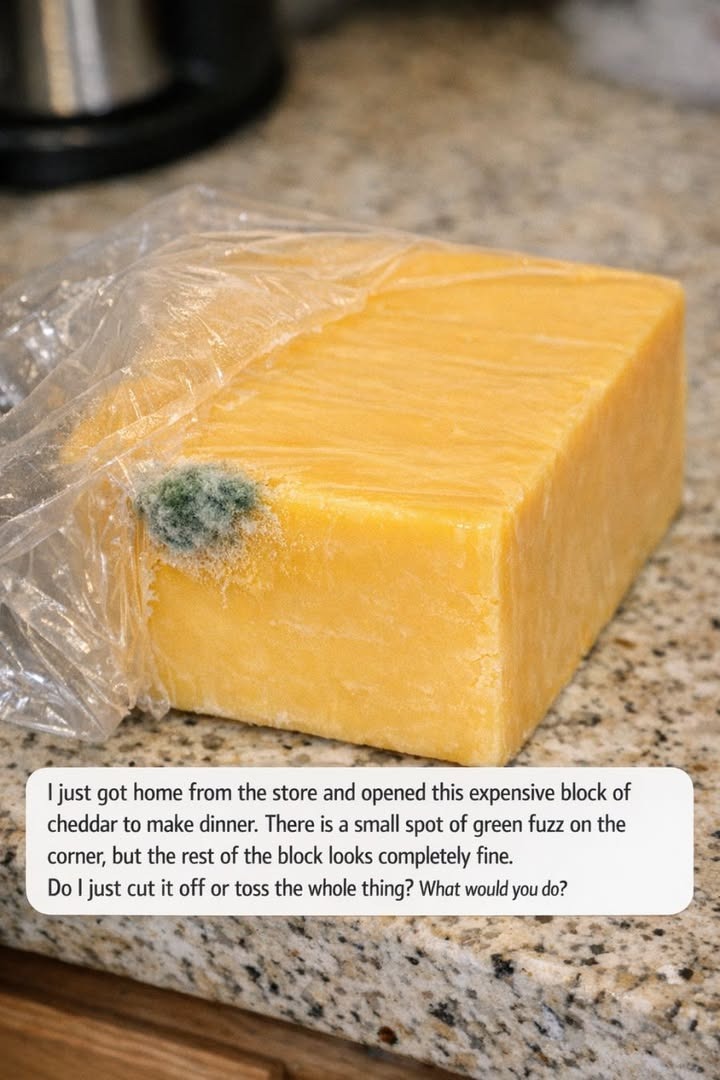
Cheese is a beloved staple in many households, and cheddar, with its rich and robust flavor, often takes center stage in various dishes. However, nothing can disrupt dinner plans quite like discovering a spot of mold on your expensive block of cheddar. The immediate question that comes to mind is whether to cut it off or discard the whole block. This dilemma is not only about food waste but also concerns health and safety.
Understanding how to safely handle moldy cheese can save you money and prevent unnecessary waste, while also ensuring that you and your family remain safe from any potential health risks. This article aims to guide you through the considerations and steps you should take when faced with mold on your cheddar cheese.
1. First, Don’t Panic: How Dangerous Is That Green Fuzz?
Spotting mold on your cheese can be alarming, but not all molds are harmful. Many molds are used in cheese production intentionally, such as the blue veins in blue cheese. However, the mold on your cheddar is likely uninvited. The green fuzz you see is usually Penicillium, a common mold that grows on food. While some strains of Penicillium can produce mycotoxins, the likelihood of significant harm from a small spot on cheese is low if handled properly.
The primary concern with mold on cheese is not acute toxicity but allergic reactions or respiratory issues, particularly in sensitive individuals. It’s essential to act cautiously but without unnecessary alarm.
2. The Science Of Moldy Cheese: When It’s Safe And When It’s Not
Cheese is a fermented product, which means that it naturally hosts a variety of microorganisms. Hard cheeses like cheddar are more resistant to mold penetration due to their dense texture. Mold typically grows on the surface and does not penetrate deeply into hard cheeses, making it generally safe to cut away the affected area, provided you remove a sufficient margin around the mold.
In contrast, soft cheeses have a higher moisture content, which allows mold to spread more easily throughout the cheese. In such cases, the entire block should be discarded, as cutting off the moldy part might not remove all contamination.
3. Hard Cheddar Vs. Soft Cheese: Why The Type Matters So Much
The type of cheese significantly influences how you should handle mold. Hard cheeses like cheddar, Parmesan, and Swiss are dense, which helps to contain mold growth to the surface. This means you can safely remove the mold and a generous portion of the surrounding cheese (at least 1 inch or 2.5 cm) without risking the integrity of the rest of the block.
Soft cheeses such as brie, camembert, and ricotta are more susceptible to mold infiltration due to their softer texture and higher moisture content. Mold can easily spread beyond what is visible to the eye, meaning you should discard these cheeses entirely if mold appears.
For Complete Cooking STEPS Please Head On Over To Next Page Or Open button (>) and don’t forget to SHARE with your Facebook friends
ADVERTISEMENT
