
Step-by-Step Instructions
Step 1 — Prepare the Crockpot
Lightly coat the inside of a large crockpot (6-quart or larger) with cooking spray. This prevents the sugary glaze from bonding to the sides of the insert during the long cook and makes cleanup considerably easier afterward. If your ham has a plastic or paper covering over the cut face, remove it before proceeding.
Step 2 — Position the Ham
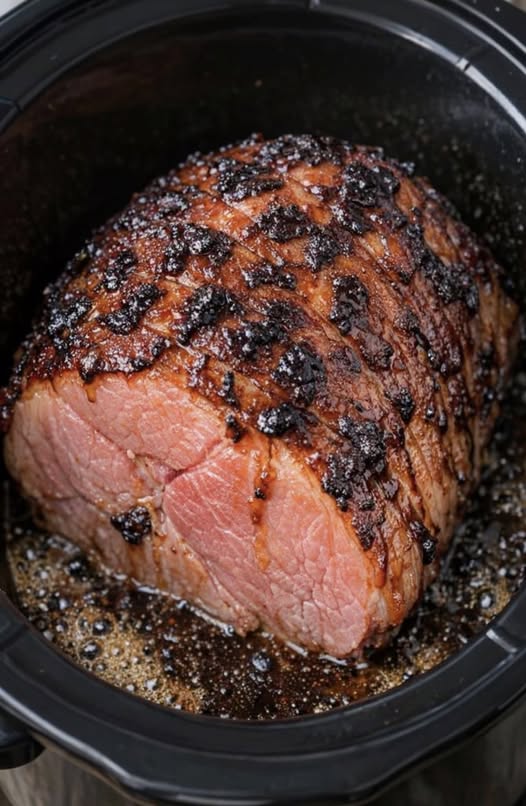
Place the ham flat-side down in the crockpot. This orientation keeps the ham stable during cooking and ensures the sliced surface of a spiral-cut ham faces upward and outward, where the glaze can flow between the cuts. If the ham is slightly too tall for the lid to close completely, try resting it at a slight angle, or trim a small section from one end with a sharp knife to reduce the height. A small gap in the lid is acceptable — it will release steam rather than trapping moisture — but a fully closed lid produces more consistent results.
Step 3 — Mix the Glaze
In a medium bowl, combine the brown sugar, honey, Dijon mustard, and ground cloves if using. Stir until the mixture is fairly uniform — the sugar won’t fully dissolve at this stage, but everything should be well combined. Pour the cola over the ham first, directing it around the sides so it pools in the bottom of the crockpot rather than washing the glaze off the surface. Then spoon or pour the brown sugar mixture over the top of the ham, using a spoon or spatula to spread it across the surface and encourage it to work its way between the spiral-cut slices. The cola and glaze will combine as they heat and create the braising liquid that builds the final sauce.
Step 4 — Slow Cook
Cover the crockpot and cook on low for 4 to 6 hours, or on high for 2 to 3 hours. Because the ham is already fully cooked, you’re reheating it rather than cooking it from raw — the goal is an internal temperature of 140°F (60°C) throughout. Low and slow is the preferred method: the longer, gentler heat gives the glaze more time to develop and penetrate the ham, and the low setting produces more moisture in the pot than the high setting. If you’re home during cooking, baste the ham once or twice by spooning the liquid from the bottom of the crockpot over the surface — this builds up an increasingly thick, glossy coating as the cooking time progresses. Basting is optional but noticeably improves the final result.
Step 5 — Reduce the Glaze (Optional but Excellent)
When the ham is done, carefully transfer it to a serving platter using large tongs or two large spoons. Pour the remaining liquid from the crockpot into a small saucepan and simmer over medium-high heat for 5 to 10 minutes, stirring occasionally, until it reduces to a thick, syrupy glaze consistency. This step takes the cooking liquid from a thin braising liquid to something closer to a proper sauce — rich, glossy, and intensely flavored. Spoon or brush this reduced glaze generously over the ham before serving and pass any remaining sauce at the table.
Step 6 — Slice and Serve
For a spiral-cut ham, the individual slices will come away from the bone easily — run a knife along the bone to release the slices if they haven’t separated fully during cooking. Arrange on a platter and spoon additional glaze over the top. Serve immediately while warm.
Tips for the Best Results
Choose a spiral-cut ham if possible. The pre-cut slices allow the cola and glaze to penetrate deep into the ham throughout the cooking process, flavoring every bite rather than just the exterior. A whole uncut ham works but produces a less deeply flavored result.
Don’t drown the ham in cola. You need enough liquid to create steam and a braising environment — about 2 cups is right for most ham sizes. The ham doesn’t need to be submerged, and too much liquid will dilute the glaze rather than concentrating it.
Reduce the cooking liquid into a proper sauce. The liquid left in the crockpot after cooking is good but thin. Taking the extra 10 minutes to reduce it in a saucepan transforms it into something genuinely excellent — a thick, sticky, caramel-colored sauce that’s worth every second of the effort.
Use a meat thermometer to confirm doneness. Internal temperature is more reliable than clock time for determining when the ham is properly heated through. Target 140°F (60°C) at the thickest point, away from the bone.
Let the ham rest before carving. Five to ten minutes of resting time after removing the ham from the crockpot allows the juices to redistribute. Carving immediately releases more moisture and produces drier slices than waiting briefly.
Frequently Asked Questions
Does the ham need to be cooked before going in the crockpot?
No — and in fact, this recipe is specifically designed for fully cooked ham, which is what most store-bought whole hams are. Check the packaging: a label saying “fully cooked,” “ready to eat,” or “heat and serve” means you’re simply reheating the ham rather than cooking it from raw. If you have a fresh (uncooked) ham, the cooking time would need to be adjusted significantly and is beyond the scope of this recipe.
For Complete Cooking STEPS Please Head On Over To Next Page Or Open button (>) and don’t forget to SHARE with your Facebook friends
ADVERTISEMENT
